Be yourself; Everyone else is already taken.
— Oscar Wilde.
This is the first post on my new blog. I’m just getting this new blog going, so stay tuned for more. Subscribe below to get notified when I post new updates.
Be yourself; Everyone else is already taken.
— Oscar Wilde.
This is the first post on my new blog. I’m just getting this new blog going, so stay tuned for more. Subscribe below to get notified when I post new updates.
Haley Trecarichi
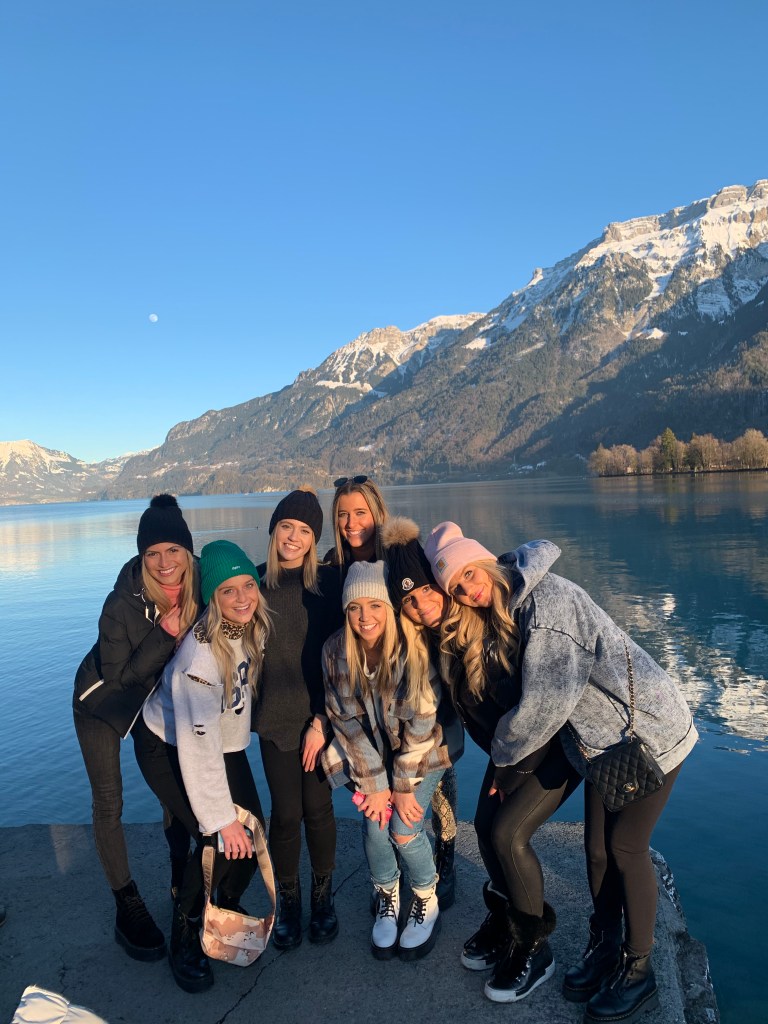
During my time in Barcelona, I used a lot of social media. The social media site that I used the most during the last few months is Instagram. I used Instagram posts and Instagram stories to share my experiences in Europe with my friends who were still in the United States. In addition to Instagram, I used Facebook and Snapchat. Every Sunday while I was abroad, I would post in an album on Facebook around twenty photos of my friends and I abroad from the previous week. I posted about Barcelona, Prague, Amsterdam, Switzerland, etc. Every new place I visited I shared a post about it on Facebook. Many of my family members are on Facebook so that was an easy way for me to share photos and experiences with my family. I used Snapchat to communicate with my friends at home and my friends who were abroad with me. Snapchat is more of an everyday app and less formal app that I use for communication rather than to post and update my followers. My most popular post was my post on Instagram when I was in Interlaken, Switzerland. I shared the post below. This post got the most likes out of all my instagram posts while I was abroad. I think the last months that I spend abroad really widened my social media platforms. As far as my digital identity, I think studying abroad and living in Barcelona gave me more of a following of people from different locations. I met people from all over the world and I also met people within my school from other places in the United States. Connecting with new people broadened my social media platform. The narrative displayed on my social media platforms during my experience abroad is a narrative of exploring. I think my posts from Barcelona and other trips I took in Europe, show me as a young adult expanding my horizons and broadening my experiences to travel to new places and learning more about completely different cultures. I think my posts display how I got to learn about new places not only by taking classes abroad, but by actually getting to travel to different landmarks and visit different important sites.
Here is a photo I posted on instagram of my friends and I in Switzerland.
By: Haley Trecarichi
Haley Trecarichi
Social media has taken over our generation and it is inevitable this will only continue and escalate for generations to come. As we have discussed in class in the past, members of generation Z expressed they do not go one day without looking at their phone. I personally, always have my phone with me, and spend approximately around eight hours on my phone each day. What do I do on my phone all this time you ask? I spend majority of those eight hours on social media networks-Instagram, Snapchat, Facebook, Twitter, etc. I use these platforms to socialize, as a form of entertainment, and as a source of information.
History shows that the newer the generation the increased time they spend on social media. Generation Z, the youngest generation, has never known a society without technology. According to The World Economic Forum, “North American, Latin American, and European Generation Z-ers lead in the number of social accounts they’re actively using” (1). Evidently from this quote, members of generation Z are active on social media around the world. This trend shows us that the next generation will only be more involved and active on social media. Generations after that will continue to increase. Therefore, this proposes an important question, how will social media activity and advancements affect future generations?
The Black Mirror episode, Nosedive, depicted a futuristic society in which social media is far advanced and integrated into everyday life. One example in the episode of social media advancements affecting their society is your phone and technology can scan any person you come in contact with. After it scans them, it gives you their profile that shares updates about their life and a rating out of five stars. This effects society in multiple ways. One of those ways is no one has to get to know each other or remember anything about each other because your phone has it all stored and instantly pops up all information you would need to know about the person. Secondly, the rating of stars that pops up instantly depicts your perception of someone. For example, a man offers Lacie a smoothie and he only has 3.2 stars which makes her question if she should drink a smoothie from him. Your star rating basically affects your entire life. It comes into play when meeting people, when buying a house, at work, etc. The star ranking takes over Lacies life, everyone she encounters depicts her based on her rating and one wrong move can lower her rating. She lets becoming a 4.5 star take over her life and it ends up hurting her because she tries to be someone she is not. I think the episode is much more into the future than just a few years. The advancements and the way everyone uses social media reflects that everyone in society has never knew a life without technology. Therefore I think it takes place in about twenty years.
One aspect of the futuristic society in the episode that I think will come into play in our societies future is how the virtual community has become all visual and photos. An article proves that “at least 50% of online searches will be carried out through image and voice by 2020″ (2). As in the episode, I believe typing will not be a thing anymore and your technology will be able to be used from your face. I think if technology is advanced in the complete way the episode shows it will have a negative impact on our society. Living now with social media I can already see how it consumes most of your day, but if everyone in society reflected and relied on a “rating” our society would be completely taken over by technology. This is negative because human interaction and first impressions are important. For example, in the episode she spills someones drink and her rating goes down, this doesn’t matter and it should be something which people perceive you on. To conclude, if social media plays a role similar to the one in the episode it will negatively change our society.
Remember that you are not alone. Life is hard, but the internet, social media, and advancements in tech have made the world a much smaller place then before. You have friends. People who care about you. You may not know them, but they are there. Don't give up. We believe in you.
— Terminally Nerdy (@terminallynerdy) May 18, 2018
(1) “The graph tells us who’s using social media the most”, Ashley Viens, accessed March 29, 2020. https://www.weforum.org/agenda/2019/10/social-media-use-by-generation/
(2) “What Will Social Media Look Like in the Future?”, Anna Ni Chiaruain, accessed March 29 2020, https://blog.logograb.com/social-media-future/
Haley Trecarichi
As a student, wikipedia is often a source that I come across immensely in research. I often choose not to use this search engine though because of the freedom users have to post and edit on it. Although, after doing this activity today I have learned that it is not as easy as I thought to create and post a wikipedia entry. Today, in this article I am going to discuss the difficulties and success I had while writing a wikipedia post.
The first and most important aspect of my wikipedia post was selecting a topic to write the post about. This was much more difficult that I suspected. The topic had to be something I was educated on, something not already on wikipedia, and something that was accurate. I found a lot of trouble in finding a subject that met all these requirements. In order to find something I went on wikipedia and typed “WP:RA” into the search engine as you can see in the screenshot below. This gave me a list of different topics and entries to look at. These topics gave me a better idea of what topic I should chose to write about.
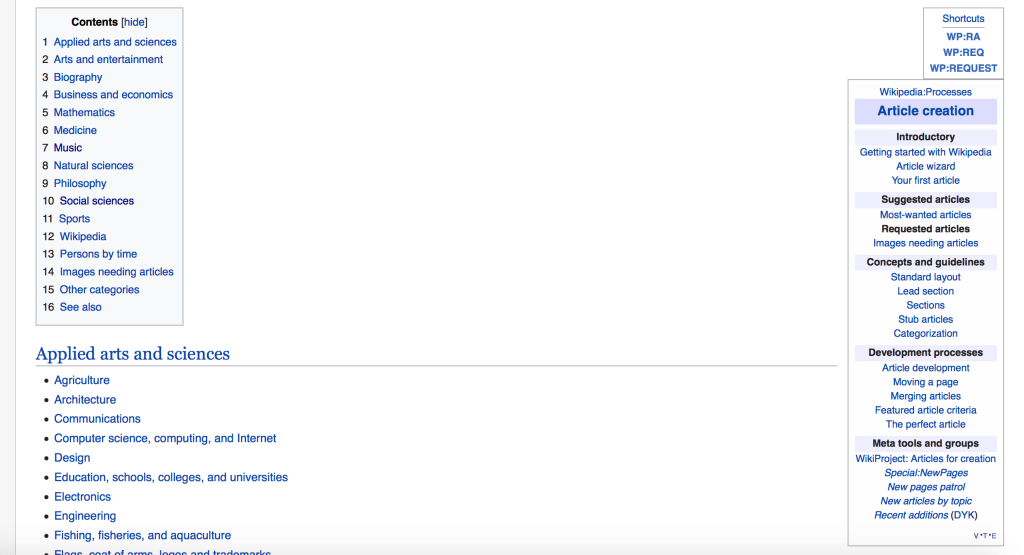
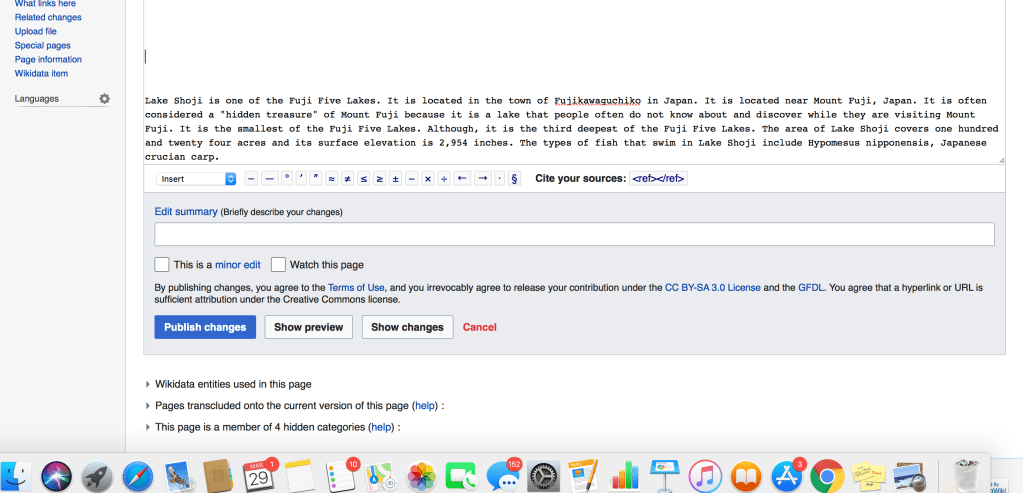
I researched and read about many different topics and articles that were already publshed on Wikipedia. The hardest part about picking a topic was finding one that was not already greatly wrote about on Wikipedia. It is a very large information platform and already had almost all of the topics I was very knowledgable about. I ended up choosing to write about Lake Shoji which is a lake in Japan. I chose to write about this because I remembered learning about it a while ago and it was something that had little information about it already on Wikipedia.
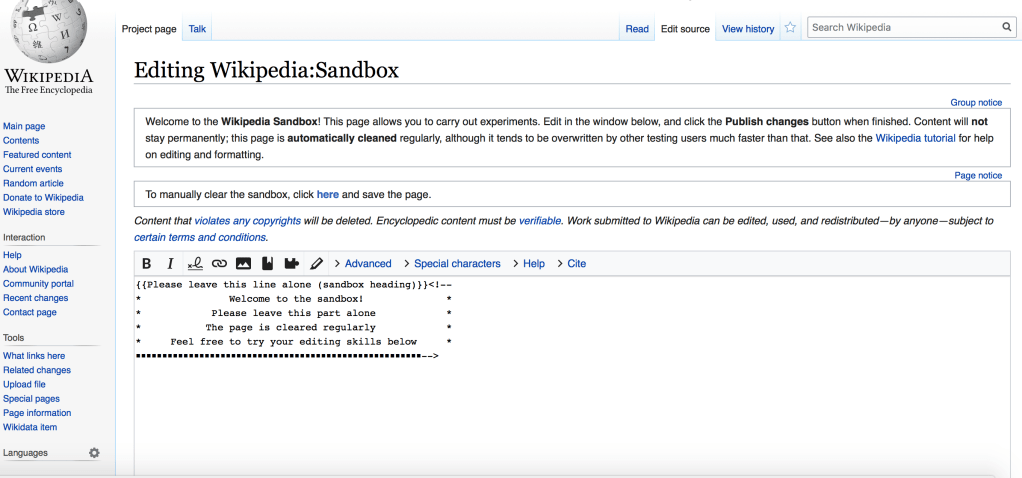
My next step was to practice writing about Lake Shoji on Wikipedias sandbox. This is a feature that Wikipedia has so people can practice writing an article and see how the process works before actually attempting to publish on Wikipedia. I typed “WR:SB” into the Wikipedia search engine and wrote everything I remembered and researched about Lake Shoji. A screenshot of Wikipedias sandbox page is below.
Finally, I searched my topic in the search engine on Wikipedia and clicked add entry. Then, I began to write about Lake Shoji. Below is my entry before I attempted to publish it.
Haley Trecarichi
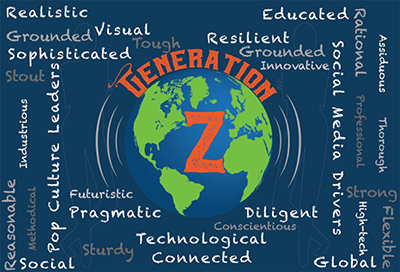
I was born in 1998 which puts me in the Generation Z. Generation Z refers to people born from 1996 to 2015. This means an age span of 4-24. A few character traits of Generation Z include independence, technologically advanced, and environmentally friendly. These are three positive characteristics of Generation Z. I think all three of these characteristics are truths. Members of Generation Z are independent because the internet allowed us to learn and research things all on our own from a very young age. According to a scholarly article on the future workforce, generation Z “prefer transparency, self-reliance, flexibility and personal freedom” (1). I think members of Generation Z are this way because we grew up with much freedom to learn on our own with technology. I am 21 years old which puts me at the beginning of Generation Z, but I still do not remember a time in my life without technology. When I was younger I would play on the computer and use AIM to communicate with my friends. My parents bought me a cell phone when I was 13 years old and ever since I have been using technology almost everyday. Therefore, I am very technologically advanced. Members of our generation are environmentally friendly because the value of the environment and laws/regulations to protect our environment became increasingly important while we were growing up. For example, while I was in high school a new class was created called Environmental Science. I took this course and learned about the value of our environment and important ways to protect it. Classes like this were not taught/offered in previous generations.
“If the leaders of the world are willing to listen carefully, they will notice that Generation Z are not asking for small tweaks. Young people are looking for fundamental changes in the way the world works…” https://t.co/IFE4S6HDZa
— DoSomething (@dosomething) February 11, 2020
Many people also expressed challenges of generation Z. One of these challenges is “Generation Z will present profound challenges to leaders, managers, supervisors, HR leaders, and educators in every sector of the workforce” (2). People believe generation Z will present challenges in the workforce because they want the quick and easy way, not the hard working and difficult way. I think this is a myth of Generation Z because people only think this due to technology. Members of Generation Z, including myself, have had access to quick and easy information our whole lives. I think in the workforce, we are implementing our quick and easy methods into old methods of previous generations. This does not mean challenges to leaders of different generations. It might even mean advancing the workplace and making things easier on previous generations. Another myth of Generation Z is that we are the same as millennials. Generation Z and millennials have multiple differences. Generation Z is a much better multi talker and internet savvy than millennials. Although millennials grew up with technology, Generation Z are “the first true digital natives” (3). We do not know a time before social media and the iPhone.
Generation Z has been using social media their whole lives. We are “digital natives” meaning we don’t remember a time before social media. Social media has shaped our lives since the time we can remember. I grew up on myspace and AIM, and now today use Instagram and Snapchat everyday. Social Media and technology are the main way my generation communicates. We are used to texting, chatting, and instant messaging versus talking on the phone or writing or communicating person. I even remember as a child using the phone to ask my friends to hangout rather than walking over to their houses to ask. Social Media has shaped us to be lazy because it is such an easy way to communicate. Why would you walk when you could reach someone via technology without having to move?
“Since they live in digitalized platforms, millennials are often disconnected from the members of the previous generations. For the most part, rather than being community oriented, they are self-centered and self-absorbed. Perhaps, this why they are known as the “Generation Me” . (Jenkins). I believe this quote by Jenkins is a complete myth and untrue. I personally do not feel at all disconnected from other generations. There is nothing self-centered about being technologically savvy and being able to operate the internet. If anything, social media such as facebook and instagram have helped me to keep in touch with relatives of different generations. For example, I update my grandma and aunts and uncles via Facebook by posting photos and statuses of things I’m doing while at college. I use my phone to FaceTime my nana while I’m studying in Europe. My nana who is obviously in a previous generation has an iPhone and I have taught her how to use it. If anything, being technologically advanced due to the generation I grew up in has kept me more connected with my extended family of different generations. Sending a text, posting a photo, or updating my status is a much quicker and more efficient way to communicate with family rather than sending a postcard or writing a letter. I am personally thankful for my elite understanding of technology so that I can use it for my own benefit and share it with older generations so they can benefit from it too.
Work Cited
(1) “Understanding The Generation Z – The Future Workforce”, Dr. A.P. Singh, Jiangguanglung Dangmeir, accessed February 2020
https://www.researchgate.net/publication/305280948
(2) “Challenges and Issues of Generation Z”, Anjali Singh, accessed February 2020 https://pdfs.semanticscholar.org/b109/73a5c6d11f37542adc34455bb0c7fbcbbb9d.pdf
(3) “Move Over, Millennials, Here Comes Generation Z”, Alex Williams, accessed February 2020 https://blogs.vsb.bc.ca/sjames/files/2012/10/Move-Over-Millennials-Here-Comes-Generation-Z-The-New-York-Times.pdf
Haley Trecarichi

Memes have taken over social cultural everywhere around the world. Photos and videos from yesterday to decades ago have been edited and captioned to create memes. These images help people connect over popular images. Richard Dawkins created a method corresponding to editing and creating memes. His method includes three components; fidelity, fecundity, and longevity. Dawkins method can help to analyze and explain every meme.
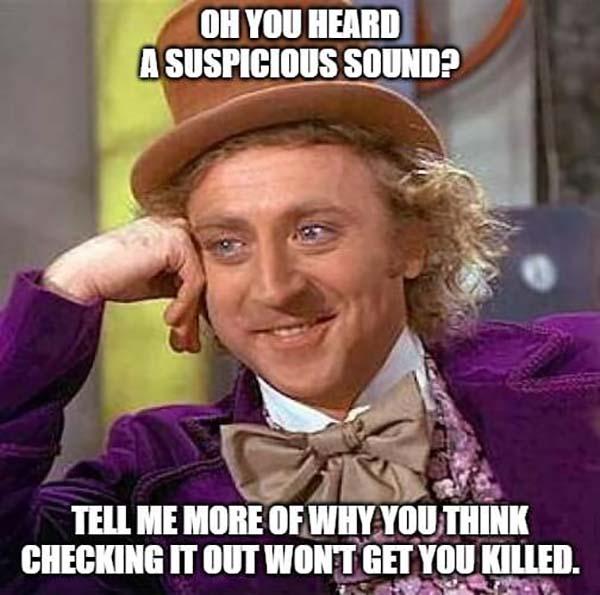
The first characterisitc of Dawkins method is fidelity. Fidelity is the ability of the image or video in the meme to allow other people to make their own caption for the photo. The Willy Wonka meme has fidelity because of his facial expression in the image. He has a very condescending look on his face which allows people to create any caption to talk down to people. It also goes with Willy Wonka’s character in the movie.
The second characteristic of Dawkins method is fecundity. Fecundity is the ability and capacity of the meme to be transformed and edited. This means how the meme can be added to, cut from, and transmitted. The Willy Wonka meme has been transformed and transmitted through different captions, editing of the background, and editing of Willy Wonka’s face. People have taken any chance to write a condescending caption on Willy Wonka’s face. Here are some examples:

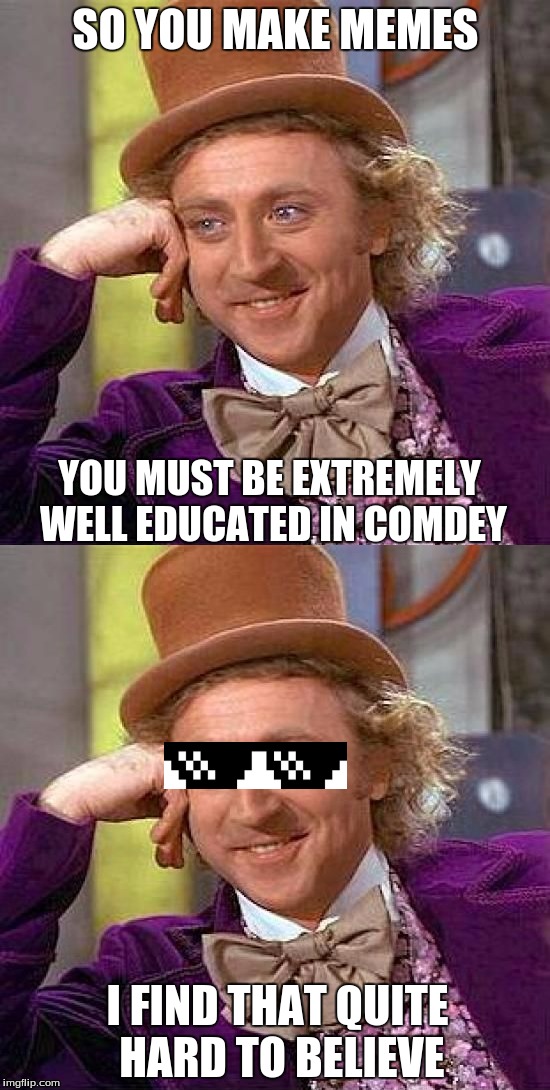
The third characteristic of Dawkins method is longevity. This means the capacity the meme has to stay in peoples memory or to live on as a meme. The Willy Wonka meme photo is from 1971 and still being used today in memes. This proves the memes longevity.
https://www.facebook.com/memeculture/
Internet memes should also include humor, intertextuality, and juxtaposition. The Willy Wonka meme has humor because of the fact that it is Willy Wonka making such a condescending face. His character does not correspond to the captions of the memes and I think that is what makes it so humorous. It has intertextuality because it has cross references through the captions and words people apply to the photo. Here is an example:

This meme shows intertextuality because it combines the condescending image of Willy Wonka with Star Wars, Twilight, The Lord of the Rings, and Harry Potter. The meme is cross referencing all of these popular culture movies with the condescending Willy Wonka face to make it an everlasting meme.
My #clcv3790 epic class is great this fall. Students bringing in discussions of intertextuality and memes with no prompting from me. pic.twitter.com/7PZczY8681
— Dr. Alexis M. Christensen (@AM_Christensen) September 18, 2019
The final characteristic of internet meme is juxtaposition. Juxtaposition is two things being placed close or next to each other in comparison. This meme does not show juxtaposition because it does not have much background or space to be compared to other things. Memes with juxtaposition have more of a scene happening around them and not just a picture of a face.
This meme is a photo of Gene Walker from his portrayal of Willy Wonka in the 1971 musical. It has developed over time and became a popular image today because of the meme culture. The photo has been edited to have condescending captions that go along with Willy Wonka’s face. The image of his has him looking down on someone as if he is better or smarter than them. It has created dry humor and sarcasm as a meme around the world.
“The Discursive Power of Memes in Digital Culture”, Bradley E Wiggins, accessed February 6 2020.
“The Social Media Reader”, Michael Mandiberg, accessed February 6 2020. http://fall2015.veryinteractive.net/content/6-library/20-the-language-of-internet-memes/davison-thelanguageofinternetmemes.pdf
“Subversive Memes: Internet Memes as a Form of Visual Rhetoric”, Heidi E Huntington, accessed February 6 2020
https://spir.aoir.org/ojs/index.php/spir/article/view/8886/pdf
Haley Trecarichi
Net neutrality is “the principle that all content on the Web should be shown on equal terms with all other content” (1).
Net Neutrality has been the basis for the internets rapid openness and freedom.
Net neutrality ensures that internet service providers (ISPs), such as Comcast, AT&T, Verizon, have no control over who can access what on the internet. Without net neutrality these large ISP’s could regulate their customers from reaching certain sites or platforms.
Net Neutrality is a hot topic in todays society because of the rapid growing use of the internet and the technological advancements that have occurred in the last decade. The principle of neutrality is affecting almost everyone in society because almost all of our society uses the internet.
According to the Journal of Internet Law, “it is first and foremost a normative debate, one that will deter- mine the role of the Internet in a democratic society, with profound implications for the daily welfare of mil- lions of citizens who rely on the Internet as a critical resource” (2).
The idea of net neutrality is that the internet should be open and free to all people. Net neutrality is a result of free speech. When net neutrality does not exist, free speech does not exist. The internet is a portal where everyone is free to search, write, and publish whatever they want. When large industries or companies take this power away from the people, freedom of speech is put at risk.
The net neutrality debate has become a government regulation issue. Does Congress implementing a law validating net neutrality violate the ISP’s rights? On the other side, does the ISP regulating their customers online experience violate customer rights? The issue has become one of privacy rights because the internet has been a free, open entity for such a long time.
Take a look at the 150 websites allowed under Kashmir's new government firewall. Netflix, Zomato, Paytm allowed but no mainstream news websites. 👇 pic.twitter.com/yGZewtopOW
— Anuj Srivas (@AnujSrivas) January 18, 2020
The repeal of net neutrality has several consequences and impacts. One of these impacts is the impact on business that occurs online. Many companies conduct business online, “thus, any change to online access policies by service providers will affect all businesses in some capacity” (3). Another implication is the effect no net neutrality will have on online purchases. With an increase in technology, Amazon, Netflix, and other online retailers are taking over the industry. Almost every store now has an online website where people can also shop. With the repeal of net neutrality, ISP’s have the ability to slow a company website and therefore hurt their customer experience. The main appeal of online shopping is that it is quick and easy, when the process becomes difficult it could deteriorate customers away from that specific site.
As a 21 year old, the Internet has been apart of my life from the time I can remember. It started with online games on a PC, and social media platforms such as AIM and myspace. Over the years with technological advancements, I do not leave the house without the internet. My phone which has unlimited access to online is always with me and I spend an average of eight hours a day online. For me, the internet is not something I have ever seen as a privilege, it is something that I have had free, easy access to my whole life. I use the internet to communicate, to network, to shop, and to research. With the repeal of net neutrality this could all change.
The Web We Want Project was created to defend, protect, and promote free will and openness of the internet. Their purpose is to “unleash the power of people across the globe to promote human rights online and a free and open Web” (4). The Web We Want Project has already made a change in some countries around the world. For example, the Web We Want Project has “helped to pass the world’s first “bill of rights for the Internet” in Brazil” (5). The project has also made significant impacts regarding internet and technology use in Turkey, Uganda, and even in the U.S. I believe the Web We Want Project is an effective platform in making a difference worldwide regarding internet usage. It is evident through the multiple ways it has already made a difference that the project works. The project has its purposes well defined and goals to enact those purposes. Although, I do believe that in addition to the Web We Project, government regulations should enact net neutrality around the world. I believe that law and regulation is the most appropriate way to ensure something gets done. A law enacting net neutrality will ensure that citizens have complete freedom to navigate the web to their liking and no privacy rights will be harmed.
(1) “Who Saved the Web?”, Solana Larsen, accessed January 22, 2020, https://webwewant.org/news/who-saved-the-web/“
(2) Transcending Net Neutrality: Ten Steps Toward an Open Internet, Journal of Internet Law, https://repository.upenn.edu/cgi/viewcontent.cgi?article=1425&context=asc_papers
(3) Implications of net neutrality repeal
https://www.jdsupra.com/legalnews/implications-of-net-neutrality-repeal-66118/
(4) “The Web We Want”, Nnenna Nwakanma, accessed January 2020. https://webfoundation.org/our-work/projects/web-we-want/
This is an example post, originally published as part of Blogging University. Enroll in one of our ten programs, and start your blog right.
You’re going to publish a post today. Don’t worry about how your blog looks. Don’t worry if you haven’t given it a name yet, or you’re feeling overwhelmed. Just click the “New Post” button, and tell us why you’re here.
Why do this?
The post can be short or long, a personal intro to your life or a bloggy mission statement, a manifesto for the future or a simple outline of your the types of things you hope to publish.
To help you get started, here are a few questions:
You’re not locked into any of this; one of the wonderful things about blogs is how they constantly evolve as we learn, grow, and interact with one another — but it’s good to know where and why you started, and articulating your goals may just give you a few other post ideas.
Can’t think how to get started? Just write the first thing that pops into your head. Anne Lamott, author of a book on writing we love, says that you need to give yourself permission to write a “crappy first draft”. Anne makes a great point — just start writing, and worry about editing it later.
When you’re ready to publish, give your post three to five tags that describe your blog’s focus — writing, photography, fiction, parenting, food, cars, movies, sports, whatever. These tags will help others who care about your topics find you in the Reader. Make sure one of the tags is “zerotohero,” so other new bloggers can find you, too.

 Haley's Blog